
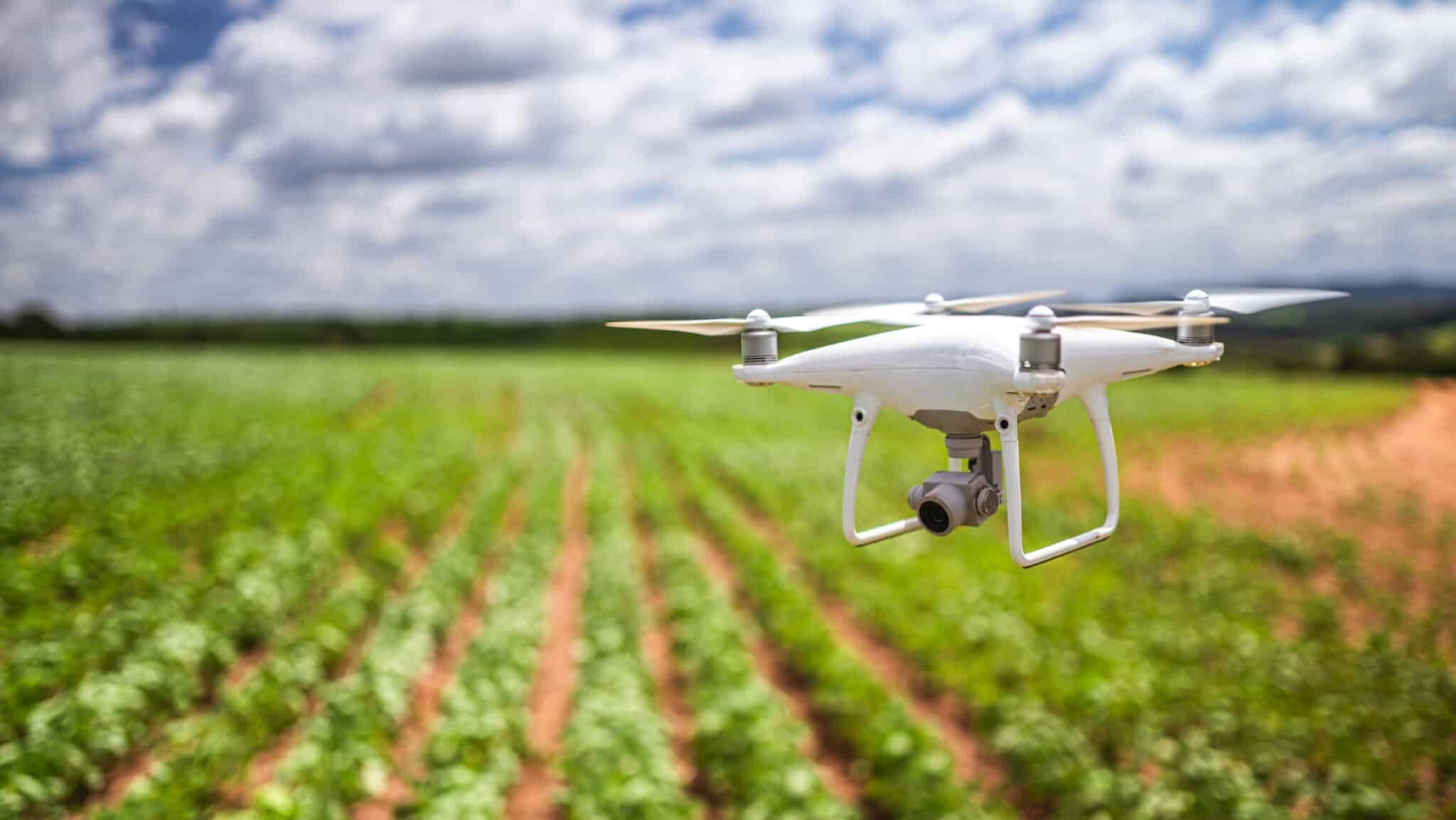
DRONES HAVE EMERGED AS A NEW AND EFFICIENT TOOL FOR APPLYING PESTICIDES. THEIR PRECISION AND ADAPTABILITY ARE CHANGING HOW PEST MANAGEMENT IS APPROACHED.
Effective pest management is a vital component of crop production. On the Prairies, ground spraying equipment and fixed-wing piloted aircraft have traditionally been used to apply pesticides in fields. The fixed-wing piloted aircrafts have also been used for pesticide application in non-crop areas such as mosquito larvicide, industrial sites and forestry applications. In recent years, drone application of pesticides has become increasingly popular.
Drones are remotely piloted aircrafts which were first introduced in agriculture as an agronomic tool. Several names have been used worldwide to refer to drones. Some of the common names used to address drones are Unmanned Aerial Vehicle (UAV), Unmanned Aerial System (UAS), Remotely Piloted Aircraft (RPA), Small Unmanned Aerial System (SUAS), Remotely Operated Aircraft (ROA), Remotely Piloted Aerial Application System (RPAAS), etc.
In Canada, Remotely Piloted Aircraft Systems (RPAS) is the term used to refer to drones. Over time, drones have advanced in scale, capability, and function, making them a versatile tool across various sectors.
Many Asian countries such as China, Japan and South Korea have successfully utilized drones for pesticide application for several years. Drone use in pesticide application in the United States is still relatively new. In Canada, drones were recently introduced as a potential new method of pesticide application and have been gaining popularity.
The growing interest in use of drones for pesticide application has sparked important discussions around the regulatory requirements governing their operation in agriculture and other areas.
In Canada, all pesticides sold or used must be registered with Health Canada’s Pest Management Regulatory Agency (PMRA) under the federal Pest Control Products Act (PCPA). The PMRA conducts a rigorous, science-based evaluation of each pesticide, including application methods, to ensure it poses no unacceptable risk to human health or the environment.
Once a pesticide is registered in Canada, it is issued a label that serves as a legal document. This label outlines important information, including the approved application methods, rates of use, wind speed and temperature requirements, and other safety guidelines. Under the Pest Control Products Act (PCPA), deviation from the instructions specified on the label is considered a violation. Therefore, only the application methods explicitly listed on the pesticide label are legally permitted.
As of Oct. 13, 2025, there are a total of five pesticide products for which drone application have been approved. All of those pesticides are approved for drone application in non-crop areas such as mosquito larvicide, right-of-way and industrial site applications. To date, in-crop drone application of pesticides has not been approved for any pesticide product.
All pesticides approved for application by drones must have RPAs mentioned on the pesticide label before they can be deployed in pesticide application. If a pesticide product does not have the RPA method of application mentioned on the label, then a drone cannot be used to apply that pesticide product.
The recent addition of drone application to a limited number of pesticide labels has sparked debate among pesticide users, particularly around whether drones are fully approved for in-crop use. Some stakeholders have called for a blanket approval that would allow all pesticides to be applied using drones. However, pesticide products and their labels are owned by individual companies, known as registrants.
Any change to a product’s approved use, including the addition of drone application, requires the registrant to submit a formal application, supported by scientific data, to the PMRA. The PMRA must then assess whether this new method of application, via drones, continues to meet the agency’s rigorous health and environmental safety standards. As a result, a blanket approval for drone use across all pesticides may not currently be feasible.
In addition to federal regulations, commercial pesticide applicators intending to use drones are also subject to provincial legislation. In Manitoba, all commercial applicators (including those intending to apply pesticides by drone) require an aerial drone licence from Manitoba Agriculture. To get the license, you must hold a drone pilot certification from Transport Canada as a pre-requisite. The drone pilot certification allows individuals to take the required pesticide certification courses (Pesticide Core and Aerial Drone).
Once an applicant successfully completes all applicable pesticide certification exams, they may apply for a pesticide applicator’s licence for the aerial drone class. The aerial drone class license will allow pilots to commercially apply approved pesticides by drones. All commercial applicators operating in Manitoba must carry valid liability and chemical injury insurance. If the insurance policy expires before the licence’s expiration date, the applicator’s licence becomes automatically invalid.
In conclusion, while drone technology holds significant potential to revolutionize pesticide application in Canada, its adoption by pesticide applicators depends on multiple factors, including federal and provincial legislation as well as economic feasibility. The current federal regulatory framework mandates that each pesticide intended for drone application undergo individual assessment and approval by Health Canada’s PMRA. Until in-crop drone application approvals are granted, applicators must strictly adhere to existing federal and provincial regulations to ensure compliance and uphold the integrity of pest management practices.